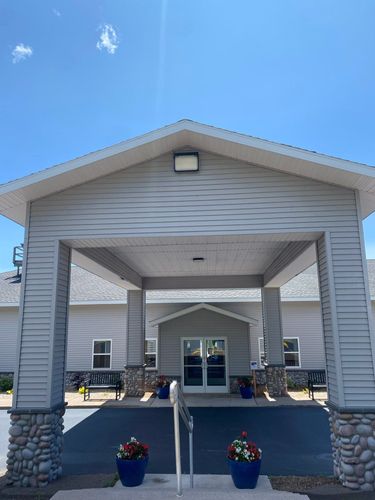
For a county at the eastern end of the Upper Peninsula, Chippewa County carries a remarkably complete medical spine. MyMichigan Medical Center Sault in Sault Ste. Marie runs a rebuilt emergency department, an intensive care unit, dialysis, chemotherapy and infusion therapy, behavioural health and a thirty-thousand-square-foot rehabilitation centre, with satellite clinics reaching across the eastern peninsula. Hearthside Assisted Living, at $3,775 a month, sits in the same city.
That combination is the reason assisted living works here at all. A county where the nearest larger hospital is a long drive can only support senior living if the everyday medicine is already local, and in the Soo it is.
What Daily Help Looks Like This Far North
Assisted living covers what has stopped being manageable alone: bathing, dressing, moving safely about the building, meals in a shared dining room, laundry and housekeeping, and medication support ranging from a spoken reminder to a trained aide administering every dose. What a family should establish is where the ceiling sits, meaning the point at which the building's staffing and licence can no longer meet a resident's needs, and how much notice they would get before reaching it.
Winter is the other half of the answer up here, and it deserves direct questions. How the building staffs through a lake-effect storm when caregivers cannot get in, what happens to medical transport when the roads close, and whether there is backup power are ordinary operational matters that a well-run building answers precisely. Vagueness on those tells a family something worth knowing.
Reading the Monthly Rate
The published figure at Hearthside Assisted Living is $3,775 a month, which covers the room, meals, housekeeping and a baseline of daily help. Sitting above it is a care charge fixed by an assessment before move-in and matched to the resident's actual needs, so a household budgeting from the published number alone is budgeting from a floor rather than a price.
That rate runs below what the same daily assistance costs in most lower-peninsula markets, which for a fixed-income household changes the plan from strained to workable. No Medicaid option sits alongside it, though, because Michigan's waiver operates only inside enrolled buildings and this county has none, so what governs a family's choices is how many years private resources can carry the assessed rate. Low local pricing makes that runway longer than it would be downstate, and that is a genuine part of the value here.
A Small Population Spread Across a Large County
Chippewa County holds roughly 36,100 people with about 7,400 of them past 65, and Sault Ste. Marie accounts for around 13,300 of the total. The rest live across townships stretched over a large and thinly settled county.
One assisted living address serving that geography means availability, rather than choice, is what a family runs into. Rooms open on turnover, and the households that have already visited and asked to be told when something frees up are the ones with a real option when the week arrives. Anyone who suspects this decision is coming within a year is better off making that call now than waiting for certainty.
Why Distance Argues for Staying in the Soo
The alternatives are genuinely far: UP Health System in Marquette holds the peninsula's only verified Level II trauma centre, 164 miles west, and McLaren Northern Michigan in Petoskey sits across the Mackinac Bridge. Those are the right destinations for major trauma and entirely the wrong basis for choosing where somebody lives, because following a hospital across that distance turns every visit into a day trip.
Staying keeps the ordinary things intact, so the same emergency department, the same dialysis chair, the same rehabilitation centre after a hospital stay, and the same church, neighbours and roads a resident has known for decades all stay within a few minutes. Caregivers and residents here also tend to come from the same community, which shows up in how quickly staff notice when someone is not themselves.
What a Local Read Adds in a One-Address County
Where a county has a single option, the useful information is not comparison but current fact: whether a room is genuinely open, what the assessed care charge adds to the published rate, how the staffing has held through the winter, and how the building handles a resident whose needs climb.
The other half is the longer arithmetic, because with no Medicaid-participating address in the county, a household planning a stay measured in years needs a clear view of how far its resources reach and what the alternatives look like well before the balance gets thin. Both conversations are free and both are better had early. If assisted living in the Soo looks likely this year, reach out now, while planning is still possible instead of reacting.
Our Chippewa County directory keeps expanding as we evaluate providers for quality and alignment in 2026. Start the conversation about assisted living in Chippewa County, or scan the buildings we cover at your own pace.