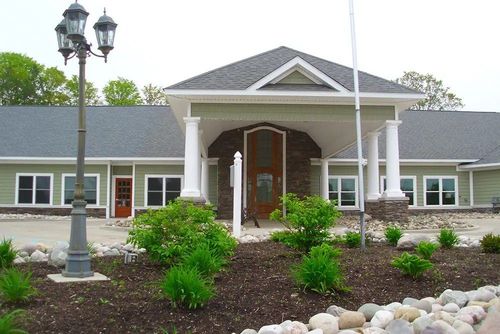
The hardest part of moving to senior living with a dog is rarely the policy. It is that in a house the dog let itself out into a fenced yard whenever it liked, and in an apartment every trip outside becomes a deliberate act performed by a person who has to put a coat on first. Mallard Cove East, at $4,100 a month, is the Petoskey address that welcomes animals, and that shift in routine is what determines whether the arrangement holds.
Petoskey does make the upside of that genuinely real. The Little Traverse Wheelway runs along the bay through the town, and a resident who still walks well has somewhere genuinely worth going rather than a lap of a parking lot.
What Changes When the Yard Goes
Count the trips honestly before anybody commits to a move. A dog that was let out five or six times a day becomes five or six deliberate expeditions, several of them in the dark, several of them across a car park in February, and all of them dependent on somebody being steady on their feet that morning.
Northern Michigan makes this a five-month question rather than a hypothetical one. Lake effect snow, ice underfoot and a long season are the reality here, and a routine that works comfortably in September is a different proposition in January. The practical questions are therefore about the property: whether there is grass rather than only asphalt, how close the nearest door is, whether the path to it is cleared and salted early, and whether staff will let a dog out on a morning when a resident cannot safely go.
Who Covers the Walk in February
This is the part that decides whether a Petoskey arrangement lasts, and it is a plan rather than an intention. A family member living locally who takes the morning trip through the worst of the winter, a paid walker covering weekday middles, or an agreed arrangement with the community about letting a dog out onto the grounds are the three that actually work. Staff will often help with a quick trip outside, but regular walking is seldom written into a care plan and should never be assumed into one.
The same plan doubles as the answer to the question every building asks at move-in, which is who takes the animal if the resident is admitted to hospital. Naming somebody who has not agreed to it is the commonest way this comes apart later, and a five-minute conversation now avoids a very bad week at some point in the future.
What the Building Charges and What the County Requires
Money comes in two pieces, a deposit taken once at the start and a charge added monthly for each animal, with refundability depending on the individual building's terms. Separately, Michigan requires that a dog carry a current license, which around here is issued by Emmet County against an up-to-date rabies vaccination, and the building will want to see both that and the wider vaccination record before an animal arrives.
Weight and breed limits are the other thing to establish, and both are usually inherited from whatever a building's insurance will underwrite rather than chosen by the building itself. That is why they rarely bend, however placid a particular dog happens to be, and why a household with a large breed should ask about it before touring anywhere.
Getting the Petoskey Details Straight
Six things repay a direct question: what the size and breed rules say this year, how many animals may be kept, what is taken at the start and what recurs monthly, how the ground outside is maintained through the winter, and who is named to step in when a resident cannot manage a walk. An advisor covering Emmet County can check each of those against the actual animal rather than against a general question about pets.
Where a dog is the thing holding up a Petoskey decision, reach out and the actual terms can be pinned down before anybody concludes it is impossible.
Our directory for Petoskey continues to grow as we evaluate providers for quality and alignment in 2026. Start the conversation about pet friendly in Petoskey, or scan the buildings we cover at your own pace.