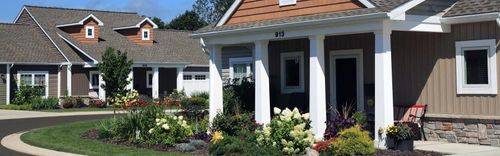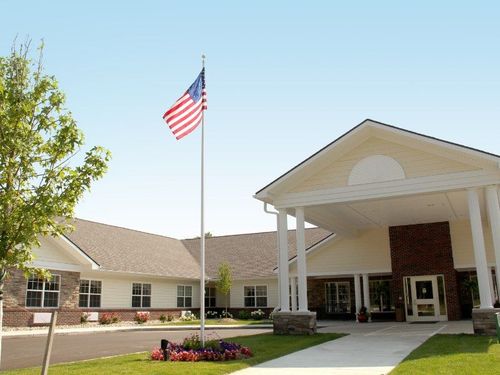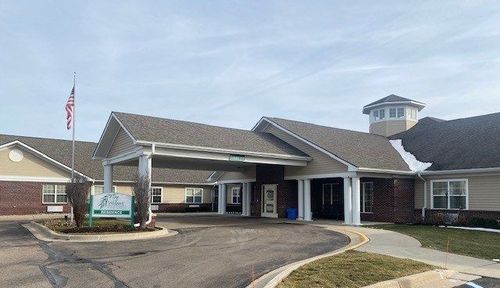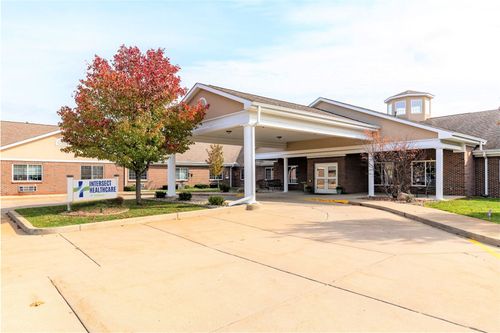

Mission Point Health Campus of Jackson carries the county seat's nursing coverage, and it takes Medicaid. At this level that second fact outweighs almost everything else, because nursing care burns through savings faster than any other kind of senior living, and changing buildings midway through a permanent stay asks the hardest thing of a household at the worst time.
Families rarely reach this page in advance, since nursing care is usually decided in the few days between a doctor saying a patient is medically ready and a bed actually being needed. What follows is written to be read quickly and to hold up under that kind of pressure.
Round-the-Clock Clinical Care Rather Than Daily Help
The line between this level and everything below it is licensure. Registered nurses are present through the night as well as the day, a physician holds the medical plan, and therapy happens on a timetable that somebody is accountable for rather than as something offered when a resident feels up to it.
Where the stay is a recovery, the therapy is the reason for it. Strength, balance and getting back on your feet fall to physical therapy; dressing, washing and managing a kitchen to occupational therapy; swallowing and speech after a stroke to a third discipline again. The question worth putting to a campus is how many hours a day a resident will actually receive, since that varies far more between buildings than the list of services does.
Who Pays, and the Point Where It Changes
Nursing care is billed by the day rather than by the month, so any figure needs converting before it can be compared with an assisted living rate. The bigger issue is not the number but the handover between payers, which catches households out repeatedly.
Where a stay follows a qualifying hospital admission for recovery, Medicare generally carries an initial period and then a share, and that support stops when a resident stops improving rather than when the family is ready. A permanent stay moves onto private funds and then, once spent down, onto Michigan Medicaid nursing coverage, an entirely separate programme from the waiver used for assisted living. Because the Jackson campus participates, that transition happens on paper rather than in a removal van.
One Campus in a County of 160,000
Jackson County counts roughly 32,400 residents aged sixty-five and over, about 20.2 percent of its people and a heavier share than Michigan's 19.6 percent.
With the county seat's nursing capacity concentrated at a single campus, availability shifts by the day rather than the season. A refusal on Monday is genuinely worth retesting on Thursday, which is an argument for somebody checking repeatedly during a discharge window rather than accepting the first answer and looking further afield.
Why Families Keep a Recovery in Jackson
Recovery is the one stage where how often relatives turn up changes the outcome, because a resident who has company pushes harder in therapy and eats more than one who sits through the afternoon alone. Keeping a stay inside the city turns visiting into something that fits around a working day.
The clinical argument runs in the same direction, since Henry Ford Jackson Hospital anchors the city with 412 beds and Level II trauma verification, carrying cardiac surgery and structural heart work, neurosurgery, joint replacement and oncology through Henry Ford Cancer, with a hybrid operating room for complex vascular procedures. A resident recovering locally stays inside the system that treated them, so the notes, the surgeon and the follow-up appointments all remain in one place, and if a recovery goes wrong the return journey is short and familiar.
Working to a Discharge Clock
Two or three days is not long to choose a nursing campus, and what a family needs in that window is factual rather than reassuring. A Local Senior Advisor covering Jackson County can establish whether capacity exists at the clinical level described, whether the campus will take the medication regimen or wound care in the notes, and how fast admission can realistically move.
Underneath sits the question that shapes everything else: whether this is a recovery with a route home or the start of a permanent stay. The two need different plans, different funding conversations and different expectations from day one, and reading it right at the outset saves a household from discovering the answer six weeks in. Anyone mid-discharge is better served by a short conversation at the start of the week than the end.
The Jackson directory continues to grow as we evaluate providers for quality and alignment in 2026. Reach out for a conversation about skilled nursing in Jackson, or look through the communities we have vetted at your own pace.