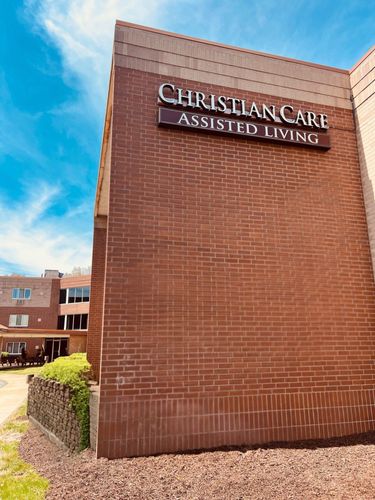
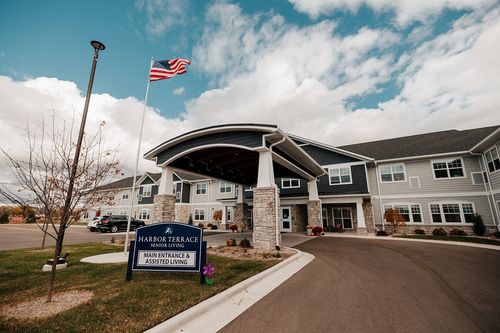

Muskegon County carries skilled nursing at two addresses rather than one, which is unusual along this stretch of the Lake Michigan shore. Christian Care Assisted Living on McLaughlin Avenue and Harbor Terrace Senior Living on Viridian Drive both sit in the city, both run between forty-five and fifty-eight beds, and both keep licensed nursing alongside lighter levels of care in the same building.
Having two is worth more than it sounds, because skilled nursing is the level where availability most often decides the outcome. A family choosing between two buildings is in a genuinely different position from one waiting on a single bed, and it changes what is worth asking about first.
The Side of the Building Nobody Tours
Most of what is written about skilled nursing describes rehabilitation: the therapy gym, the discharge date, the few weeks after a hip or a stroke. The other population is larger in a building like these and gets discussed far less. These are residents whose conditions require licensed nursing permanently, and whose stay is measured in years rather than weeks.
What that side of a building does well or badly is invisible from a therapy schedule. Ask the ratio of certified nursing assistants to residents on the long-stay wing at three in the morning rather than at eleven. Ask how long the nursing staff have been there, how often residents go back to hospital and for what, and how the building handles someone who can no longer say what is wrong.
Where the Money Comes From, in Order
Skilled nursing runs on a funding sequence rather than a price, and knowing the order matters more than knowing any single number. A stay that begins after a qualifying inpatient hospital admission of three nights starts on Medicare, which pays in full for twenty days and then charges a daily co-payment through day one hundred before stopping altogether.
After that the stay converts to private pay, and the rate is far above anything on the assisted living side of these buildings, whose published figures of $4,013 at Harbor Terrace Senior Living and $4,400 at Christian Care Assisted Living describe a different product entirely. One of the county's two skilled settings participates in Medicaid, which is where most long stays in Michigan eventually land once assets are spent. Establishing which one, and starting the application while Medicare days remain, is the single most useful piece of preparation available here.
Volume Set by a Level II Trauma Center
Demand for skilled beds tracks hospital discharges rather than county population, and Muskegon's hospital is a substantial one. Trinity Health Muskegon runs a two-hundred-and-sixty-seven-room medical center with a sixty-seven-bed emergency room and a Level II trauma verification held since 2015, serving the shoreline north of Grand Rapids.
A hospital that size discharges continuously, so beds turn on clinical cycles and availability can change inside a day. With around 35,000 county residents past 65 feeding into it, and referrals from up and down the lakeshore, a bed identified on Monday is not a bed reserved on Wednesday.
Why the Long-Stay Family Stays in Muskegon
A rehabilitation stay is measured in weeks and a family can absorb a drive for that long. A long stay is measured in years, and over that span the visiting pattern is the relationship. Somebody who can call in after work on a Thursday sees a resident's week; somebody driving in monthly sees a summary of it.
That matters more at this level than at any other, because a long-stay resident often cannot report their own experience. Weight loss, a pressure area, a new confusion, a staff change that has altered the feel of a wing: those get noticed by people who are physically present often enough to spot a difference. Both of the county's skilled addresses sit in the city, so for a Muskegon family the frequent visit stays realistic rather than becoming an expedition.
Two Buildings and a Very Short Clock
Skilled nursing decisions are made on a schedule set by a discharge planner, and the questions that decide them are narrow. Whether a bed exists at the required clinical level and by when, whether the building is staffed for the specific problems the resident brings, and how the Medicare days line up against the stay anyone realistically expects.
The financial question follows immediately and is far easier settled early. Which building takes Medicaid, when an application has to open, and what paperwork it demands can all be sorted while the resident is still on the ward. Having two buildings to compare only helps if somebody knows the present state of both, which nothing published does. When the date is already on the whiteboard, a short conversation turns two names into a decision.
The Muskegon County directory continues to grow as we evaluate providers for quality and alignment in 2026. Start the conversation about skilled nursing in Muskegon County, or look through the buildings we cover at your own pace.