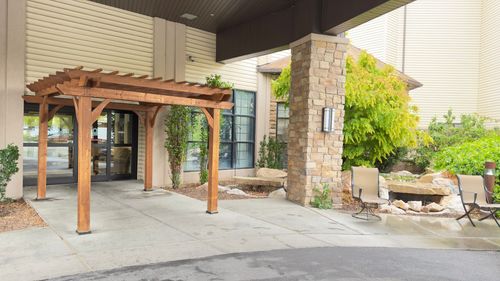

When a Brigham City family is told the next step is skilled-nursing care, the question almost always comes down to geography. Maple Springs of Brigham City sits on Medical Drive on the south end of town and is the only address in Box Elder County offering skilled-nursing-level care as part of a continuum; independent living, assisted living, memory care, and skilled nursing all under the same 60-resident roof. The alternative is a thirty- or forty-minute drive south to one of McKay-Dee Hospital's long-term-care wings in Ogden, where the inventory is deeper but the visiting routine becomes a half-day operation rather than a fifteen-minute stop on the way home from the grocery store.
That geographic trade-off shapes most of what families weigh, more than the cost or the clinical specifics. A spouse who used to walk a few blocks to the Tabernacle on Sunday is not going to drive an hour round-trip to Ogden three times a week for visits. Adult children who have built a routine around weekly stops at the parent's apartment in the assisted-living wing at Maple Springs don't want to lose that routine just because the resident's clinical needs took a step up.
Maple Springs's Continuum, Up Close
Maple Springs's skilled-nursing tier is a defined wing inside the broader 60-resident building. The same dining hall serves residents from all four tiers, the same garden courtyard, the same front door; but the skilled wing carries the staffing depth a nursing-facility level of care actually requires. Registered nurses are on duty rather than on call, awake-overnight clinical staff manage the hours when the rest of the building goes quiet, and medication administration, IV management, and post-acute wound care all happen on-site rather than requiring an emergency-department trip.
Rehabilitation services run through the building too. Physical, occupational, and speech therapy schedules attach to each resident's care plan during the post-acute rehabilitation phase, typically the first sixty to ninety days following a hospital event. Therapy partners with the building's nursing staff so the rehab work and the daily clinical management are coordinated rather than handed back and forth.
What the small building gives up (Maple Springs has one wing for skilled, not multiple specialized units), it tends to make up in continuity. A resident transitioning from the assisted-living wing into the skilled-nursing wing keeps the same family routine intact. Visiting hours stay the same, the dining hall stays the same, and most of the staff faces are already familiar from the earlier tier.
How the Bills Actually Work
The pricing structure for skilled nursing differs from anything families are familiar with in assisted living or memory care. Maple Springs's skilled tier prices by the day rather than the month; typically $300 to $400 a day in 2026, depending on the resident's clinical acuity, whether the room is private or shared, and how much rehabilitation therapy is built into the daily care plan. Across a typical month that comes to roughly $9,000 to $12,000, which sits below comparable Wasatch Front rates because the broader Box Elder cost basis is lower.
Medicare carries the first hundred days of a qualifying post-acute stay (days one through twenty at no cost to the resident, then a daily copay through day one hundred). After that, three paths open: continued private pay, long-term-care insurance for households who bought coverage years earlier, or traditional state Medicaid for residents who clear a tighter clinical and financial screen than the Aging Waiver uses. The Aging Waiver (the Medicaid program that covers assisted living and memory care) does not extend to skilled nursing; long-term skilled nursing runs through Utah's traditional Medicaid program with stricter income and asset limits.
Maple Springs's admissions team works through the post-Medicare transition case by case, and the hospital case manager from Brigham City Community Hospital is usually the right starting point for confirming whether the Medicaid application timeline and the Maple Springs bed availability line up.
Local Capacity and Out-of-City Backup
For most Brigham City families, this is the actual decision, not a footnote. Maple Springs's single skilled wing has fewer beds than the larger hospital-based long-term-care programs short of the corridor, which means availability isn't always there when a discharge clock is ticking. Brigham City Community Hospital's case managers tend to know the building well and will call before the discharge timeline forces a choice.
When Maple Springs has the bed and the clinical profile fits, the answer is almost always to stay local; the visit cadence, the medical relationships on Main Street, and the continuity for the spouse or family member already at the building all weigh more than the small-scale clinical staffing trade-off. When Maple Springs is full or the resident's profile requires a higher acuity than the skilled wing can safely manage, the discussion shifts to out-of-city long-term-care inventory, where the bed count runs deeper but the family has to absorb the visiting trade-off.
Families whose long-horizon plan already runs through Maple Springs (a spouse already in the assisted-living wing, a parent who entered the building at independent-living tier years earlier) have a real advantage here. The continuum structure means the skilled-nursing step doesn't require a separate facility selection process, just a clinical re-assessment and a move down the hall.
What the Box Elder Advisor Helps With
A skilled-nursing decision in Brigham City moves fast. Most start with a call from a hospital case manager, and the family has 48 to 72 hours to confirm a placement. The advisor works the question in parallel with the case manager: confirming whether Maple Springs has the bed, walking the family through the Medicare-and-Medicaid mechanics for the next ninety days, and laying out the McKay-Dee alternatives if Maple Springs can't take the case.
For families on a longer planning track; a couple in their seventies thinking about where they want to be in ten years, an adult child whose parent is already at Maple Springs's assisted-living wing; the conversation looks different. The continuum's advantage becomes a real consideration rather than just a feature: building a relationship with the Maple Springs admissions team before any skilled-nursing crisis arrives keeps the family inside the building when it does.
The Brigham City skilled-nursing picture continues to evolve as we evaluate new providers through 2026. Reach out when a discharge call comes through and you need same-day clarity on Maple Springs, or view our Brigham City senior-living set for the broader local context.