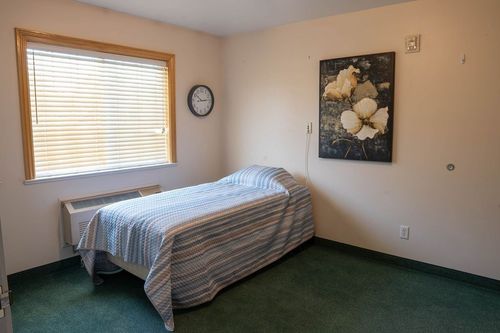

Elmo's dementia-care picture sits inside one address: GoodLife Senior Living of Elmo on West 100 North, a 16-resident faith-based building that combines assisted living with active Alzheimer's and dementia care under one roof. The community's published description names memory care as a core service rather than a side capability, with a licensed registered nurse overseeing medication management and 24-hour staffing covering the household's care load.
The scale is the defining feature for an Elmo family weighing the dementia question. Sixteen residents share one kitchen, one dining room, one set of common areas, and one rotating care team, so dementia support runs as concentrated attention across the building rather than a separately walled secured neighborhood. For a resident whose comfort depends on the recognition of a small number of familiar faces, that household structure can hold longer than a busier campus environment would.
Day-to-Day Dementia Care
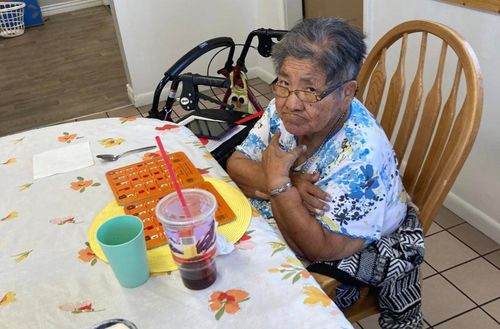
Dementia residents at GoodLife move through the same daily rhythm as the rest of the building: home-cooked meals from the on-site kitchen at three set times, scheduled fitness blocks, arts and crafts activities, and quieter afternoon stretches paced to what the resident can engage with comfortably. Caregivers cover the household around the clock and a licensed registered nurse oversees the medication program; the awake-overnight presence and the small caregiver-to-resident ratio give the building structural advantages that matter when a confused resident wakes disoriented at 2 a.m.
The practical limit of the household format shows up when dementia behaviors escalate past what a 16-resident building can manage safely (significant exit-seeking pressure beyond simple supervision, repeated multi-person physical-care episodes per day, or behavioral complexity that needs a dedicated dementia-trained ratio rather than a household one). For Elmo families approaching that threshold, the realistic alternative sits at the Utah Valley corridor's purpose-built secured neighborhoods roughly two hours northwest along U.S. 6 and I-15.
Cost and Coverage
GoodLife's dementia-care monthly rate in 2026 runs roughly $3,800 to $5,100. The starting figure tracks small-residential rural Utah pricing, which sits noticeably below Wasatch Front secured-wing rates because Emery County's labor and real-estate basis is lower. Apartment selection and the move-in care-tier rating account for most of the spread inside the band. Move-in fees fall $500 to $2,500 by room, couples sharing add $400 to $700 monthly, and short-stay respite costs $130 to $190 a night.
GoodLife does not currently hold an Aging Waiver contract. For Medicaid-track Elmo families needing Waiver coverage on dementia care, the participating buildings sit at meaningful distance from Emery County, which means the visit-cadence trade-off becomes part of the conversation alongside eligibility timing. Private-pay funding sustained by long-tenured family-land equity is the most common path for households who plan to keep the resident inside the Carbon-and-Emery cultural anchor.
Local Healthcare Access
Castleview Hospital sixteen miles north in Price handles the medical events that surface in dementia care: urinary infections presenting as confusion, fall-related workups, medication-interaction reviews, and the acute-care needs the building does not manage in-house. Emery Medical Center fifteen minutes south in Castle Dale covers outpatient family-practice and urgent-care visits within an easy drive. Higher-acuity neurology consults and dementia-specialist follow-up typically route to the Utah Valley corridor at Utah Valley Hospital in Provo or the University of Utah Health geriatric program in Salt Lake City, both reached in roughly two and a half hours along U.S. 6 and I-15.
That hospital geography shapes the Elmo dementia experience in a specific way: routine clinical events run locally without long drives, but the specialist depth that paces the first year after diagnosis (cognitive workups, behavioral-health consults, medication trials) usually involves planned trips to the Wasatch Front rather than next-day appointments down the street.
Why Families Choose Memory Care in Elmo
The core pull is staying inside the Carbon-and-Emery cultural fabric. Long-tenured Elmo households with roots in multi-generational ranching, alfalfa farming, and the local coal-economy history carry a strong case for keeping the dementia resident close to family land, ward connections built across decades, and the Sunday-dinner rhythm that anchors the household. A resident whose dementia diagnosis has already disrupted orientation often holds onto familiar place-based cues longer than abstract memories, and the plateau setting itself functions as one of those cues for many longtime residents.
The small household scale also matches what many Elmo families expect from a senior-care setting. The 16-resident format reads closer to a large family home than a campus, with caregivers learning each resident's lifetime story rather than treating dementia care as a clinical assignment.
What a Local Advisor Brings to Elmo
Most Elmo dementia conversations open through slow accumulation rather than a hospital event. Adult children calling in from Price, Castle Dale, or further afield notice that home routines have begun slipping in ways the household cannot patch: overnight unpredictability, repeated medication mistakes, wandering that has crossed from occasional into worrying, and a family rotation that has reached the limits of what schedule-stacking can sustain. The advisor's first move is checking GoodLife's current availability against the family's timing.
When the building fits, the conversation moves into apartment selection, move-in fees, and the care-tier rating that shapes the monthly figure. When timing or dementia stage doesn't align with what a 16-resident household can hold safely, the advisor walks through the realistic alternatives along with the visit-cadence trade-off honestly: the Utah Valley corridor's purpose-built secured neighborhoods carry the deeper dementia infrastructure, but the two-hour drive each direction shifts the family-visit pattern in ways that matter for a dementia resident.
Getting a planning call on the books before the home situation tightens around a hospital release leaves room to evaluate GoodLife properly. Get in touch when memory care in Elmo is on the table, or browse the buildings we cover for the broader Castle Country and Wasatch Front dementia-care context.