
North Logan, UT

Skilled Care Communities in North Logan

One skilled care community in North Logan, UT — with free, unbiased guidance from local advisors.

1
Community
1
Community
$10,500
Avg. Monthly Pricing

Explore Skilled Care Communities in North Logan

One skilled care community to review, with free guidance from a local advisor.

View all communities in North Logan
Randy Chipman, MBA, CSA, CPRS

North Logan Skilled Care Advisor

Randy Chipman, MBA, CSA, CPRS

Certified Senior Advisor

Randy personally knows every skilled care community in North Logan. Get free, unbiased recommendations tailored to your family's care needs, budget, and timeline — no sales pressure, no obligations.

What to Expect From Skilled Care in North Logan

  • Inventory: 1 community in North Logan for 24-hour clinical care.
  • Setting mix: 1 community in the matching set.

Skilled nursing is the level of care where the staffing requirements change shape. A resident moves from caregivers who help with bathing and medication reminders into a setting where registered nurses are on duty around the clock, where IV medications and post-surgical wound care happen on-site rather than in an emergency room, and where the clinical work that an assisted-living building would refer back to a hospital can be managed in-house. Most Cache Valley families reach this level after a hospital event; a fall, a serious infection, a stroke, or a chronic condition that has finally outpaced what home and assisted living can cover safely.

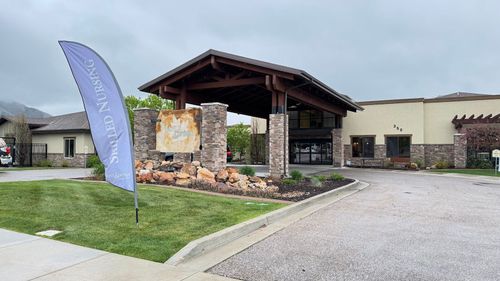
In North Logan, the address that holds a licensed skilled-nursing wing is Maple Springs. The building runs three care tiers under one roof on East 2200 North: assisted-living apartments through the bulk of its 80-bed resident set, a secured dementia neighborhood behind controlled doors, and the skilled-nursing rooms anchoring the clinical end of the campus. Within Cache Valley, Maple Springs is one of a handful of skilled-nursing addresses outside the hospital long-term-care wings. Terrace Grove in Logan offers comparable depth on the memory-care side but with a different operating model; Logan Regional Hospital and Cache Valley Specialty Hospital handle the inpatient post-acute stretch. Beyond the Cache Valley line, the next-deepest skilled-care inventory is at McKay-Dee Hospital's long-term-care wing in Ogden, forty-five minutes south on I-15.

What the Continuum Buys You

The meaningful thing about Maple Springs's structure isn't the skilled-care wing in isolation. It's the way the wing connects to the rest of the building. A resident who joined Maple Springs years earlier through the assisted-living wing or moved later into the memory-care neighborhood doesn't have to relocate to a separate skilled-nursing facility when clinical needs intensify. The room changes; the daily caregivers, the dining schedule, the visiting routine, and the spouse or partner who may still be in an earlier-tier apartment all stay the same.

For a Cache Valley family, that continuity is often the deciding factor. The alternative; discharging from Logan Regional to a hospital-based long-term-care unit, then potentially transferring again to a different facility once Medicare's window closes; introduces two or three points where the resident has to adjust to a new building, a new clinical team, and a new daily routine. Each transition is a clinical risk for someone whose health is already fragile.

For a family that arrives at skilled-nursing care directly from a hospital discharge without any prior connection to Maple Springs, the building's small scale becomes the question. The skilled wing has fewer beds than a hospital-based program, which means availability isn't always there in the 48-to-72-hour window a discharge typically allows.

Clinical Staffing and Daily Routine

Maple Springs's skilled wing operates under nursing-facility licensing rules, which means staffing follows a different pattern than the assisted-living or memory-care wings in the same building. Registered nurses cover each shift rather than being on call from elsewhere. Licensed practical nurses and certified nurse assistants supplement the RN coverage. Awake-overnight clinical staff are in the wing rather than at a central building station; important for residents who may need IV medication adjustment, oxygen monitoring, or pain management overnight.

Daily rehabilitation services attach to each resident's care plan during the post-acute phase. Physical therapy works on mobility recovery; occupational therapy on activities-of-daily-living skills (dressing, transferring, eating); speech therapy on swallowing or post-stroke communication. The intensity depends on the resident's progress and clinical orders; a typical rehab schedule runs five to seven days a week in the first month, tapering as the recovery curve flattens.

Family visiting is open across the day. The skilled wing keeps a quieter side room for visits that need a calmer space; useful after a clinical morning that left the resident more tired than usual.

How Skilled-Nursing Pricing Works

Maple Springs's skilled-care tier prices by the day, not by the month. The 2026 daily rate runs $300 to $400, varying with the resident's clinical acuity, the room type, and the rehabilitation intensity built into the care plan. Across a thirty-day month that comes to roughly $9,000 to $12,000. Cache Valley pricing settles a step under what equivalent Wasatch Front skilled-nursing tiers charge, since the regional cost basis on labor and operations runs lighter here.

Medicare's coverage runs first for residents arriving after a qualifying hospital stay: the first twenty days carry no out-of-pocket charge for the resident, days twenty-one through one hundred shift to a per-day copay. After Medicare's window closes (most residents either stabilize and discharge, or continue to need facility-level care indefinitely) the payment question shifts. Continued private pay is the simplest path for families with the means. Long-term-care insurance, if the family bought it years earlier, can carry the cost depending on the policy's benefit triggers and daily caps. Traditional state Medicaid covers long-term skilled nursing for residents who meet a clinical assessment confirming nursing-facility level of care and whose household income and assets fall below tighter program limits than the Aging Waiver uses.

Maple Springs's admissions team works the Medicaid transition case by case, and Logan Regional Hospital case managers usually coordinate the eligibility paperwork during the post-acute discharge planning so it's in motion before Medicare's window closes.

How Families Actually Approach the Conversation

Most Cache Valley families reach skilled-nursing care through a hospital event rather than a planning conversation. The phone call from Logan Regional's case-management team usually arrives during a discharge window; anywhere from a few days to two weeks of notice that the resident needs facility-based nursing rather than a return home. The advisor's role in those situations is to translate the clinical discharge profile into a same-day availability check at Maple Springs, lay out the McKay-Dee alternatives if Maple Springs is full, and walk the family through the Medicare-and-Medicaid mechanics over the next ninety days.

For families with a longer planning track; a spouse already living at Maple Springs's assisted-living wing, a parent who entered the building through independent-living elsewhere in the family's history, an adult child watching a parent's chronic-condition curve; the conversation moves at a different pace. The advisor's job becomes laying out how the continuum structure would actually work when the time comes: which clinical signs typically signal the transition, how the building handles family visits across tier transitions, and what the spouse's daily routine would look like if the partner moves to the skilled wing.

Reaching out to the advisor before a hospital event surfaces options that don't always show up through case-management channels alone. The North Logan skilled-nursing picture continues to evolve through 2026. Talk it through when a Logan Regional discharge call brings the question forward, or view our Cache Valley senior-living set when there's still planning room ahead.

Randy Chipman, MBA, CSA, CPRS

Randy Chipman, MBA, CSA, CPRS

Certified Senior Advisor, Utah

Advisor Insight on
Skilled Care in North Logan

Maple Springs of North Logan is Cache Valley's main on-site skilled-care option outside hospital long-term-care wings. The continuum advantage matters most when a spouse or parent is already at Maple Springs; the skilled-wing transition becomes a move down the hall rather than a relocation. The advisor coordinates with Logan Regional case managers during discharge windows.

Nearby North Logan Hospitals and Local Essentials

  • Hospital:Logan Regional Hospital, five minutes south, is the Cache Valley acute-care anchor. Cache Valley Specialty Hospital handles outpatient and specialty rehab. Heavier acute cases route forty-five minutes south to McKay-Dee Hospital in Ogden.
  • Dining:Lee's Marketplace, Smith's, and Macey's give in-and-out grocery stops near the building. Sit-down meals after a longer hospital-coordinated visit work well at the Bluebird Restaurant downtown or the Logan Tabernacle-adjacent cafes.
  • Shopping:Pharmacy counters at Walgreens, Smith's, and Macey's along State Highway 91 sit five minutes from Maple Springs. The Cache Valley Mall and USU campus events extend the visit calendar.

Maple Springs sits on East 2200 North in North Logan, close to USU faculty residential blocks, the State Highway 91 commercial spine, and a five-minute drive to Logan Regional Hospital.

Skilled Care Communities Near North Logan

Skilled Care communities within 50 miles of North Logan.

Frequently Asked Questions About Skilled Care in North Logan

Why does skilled nursing at Maple Springs cost more than memory care at the same building?

The pricing difference reflects the staffing depth. Maple Springs's memory-care wing carries dementia-trained caregivers and awake-overnight staff but operates under residential-care licensing; the clinical work happens through visiting nurses or hospital trips rather than on-site round-the-clock RNs. The skilled wing operates under nursing-facility licensing, which mandates registered nurses on every shift, certified nurse assistants in tighter ratios, and the ability to manage IV medications, post-surgical wound care, oxygen, and complex symptom management directly. Medicare and Medicaid both pay skilled facilities through different channels than they pay assisted living or memory care, which also reflects the regulatory and clinical difference. Daily rates of $300-$400 at the skilled tier roughly double the assisted-living monthly rate at the same building when divided across thirty days, but the licensed clinical scope is qualitatively different.

How does the Medicare-to-Medicaid transition work for a Maple Springs skilled-care stay?

Medicare covers a qualifying post-acute skilled-nursing stay for up to a hundred days; the first twenty days carry nothing out-of-pocket for the resident, and from day twenty-one through day one hundred a per-day copay (around $200 in 2026) kicks in. The qualifying condition is a three-day hospital stay followed directly by skilled-nursing admission within thirty days. After day one hundred, Medicare stops covering the stay regardless of clinical need. Families with means continue privately, those with long-term-care insurance activate those benefits, and households fitting traditional state Medicaid's tighter income and asset limits begin a Medicaid eligibility review. Logan Regional's case managers typically start the Medicaid paperwork during discharge planning when the resident's clinical needs may extend past Medicare's window. Maple Springs's admissions team coordinates the paperwork with the state Medicaid eligibility office case-by-case.

What's the difference between staying at Maple Springs's skilled wing versus going to a hospital long-term-care unit?

Maple Springs's skilled wing operates as part of a four-tier continuum; meals come from the same kitchen that serves the rest of the building, visiting family can come and go on the same schedule as visits to other Maple Springs tiers, and a resident transitioning from an earlier tier keeps the same staff relationships and daily routine. A hospital long-term-care unit operates inside or attached to an acute-care hospital, with a more clinically oriented atmosphere, narrower visiting hours in some cases, and a separate set of staff from any earlier care relationship. For residents arriving directly from a hospital discharge without a prior connection to Maple Springs, the hospital long-term-care option can offer faster admission since beds turn over on the discharge cycle. For residents whose spouse, sibling, or parent is already in Maple Springs's earlier tiers, the continuum advantage almost always tips the decision toward staying at Maple Springs.

How long does a typical skilled-nursing stay last?

Two patterns are most common. The first is a post-acute rehabilitation stay following a hospital event; a fall with hip fracture, a stroke, a serious surgery. These typically run thirty to ninety days, with the resident discharging home or stepping back to an assisted-living setting once mobility and daily-task independence have recovered enough. The second is a long-term skilled stay for residents whose chronic conditions can't be managed safely at a lower level of care; advanced Parkinson's, late-stage heart failure, advanced dementia with complex medical needs. These stays continue indefinitely, with the financial path shifting from Medicare to private pay or Medicaid over time. Maple Springs's skilled wing handles both patterns; the admissions team and the family's clinical team typically have a clearer sense of which pattern applies after the first thirty days.

When should a Cache Valley family start talking to the advisor about skilled nursing?

Most Cache Valley families reach the advisor during a hospital discharge window; a Logan Regional case manager has surfaced the question and the household is working inside a two-to-three-day decision window before the bed has to be locked in. That's a normal entry point and the advisor's coordination process is built for it. But families whose situation is foreseeable; a spouse already at Maple Springs's assisted-living or memory-care wing, a parent with a chronic condition whose curve points toward eventual skilled-nursing needs, an adult child managing a parent's clinical care from a distance; benefit from a conversation earlier than the discharge window forces it. An early conversation lets the family understand how the continuum works, build a relationship with Maple Springs's admissions team, and have the Medicare-and-Medicaid mechanics already mapped out when the day arrives that the question becomes urgent.

Get Help Finding Skilled Care in North Logan

Our local advisors know every skilled care community in North Logan personally. Get free, unbiased recommendations tailored to your family's care needs, budget, and location preferences.

Free service · No obligation · We only recommend what's right for you