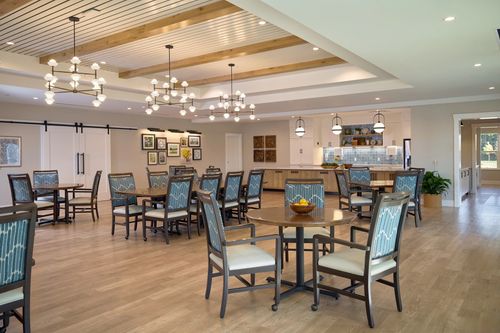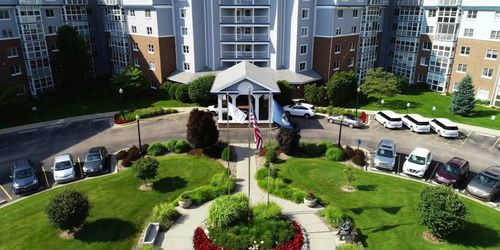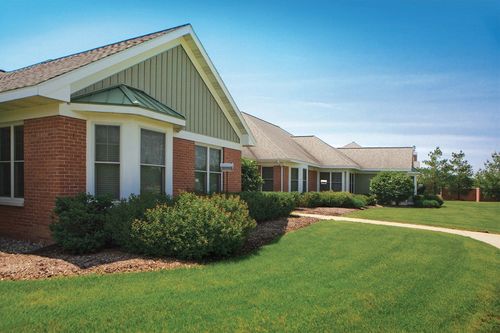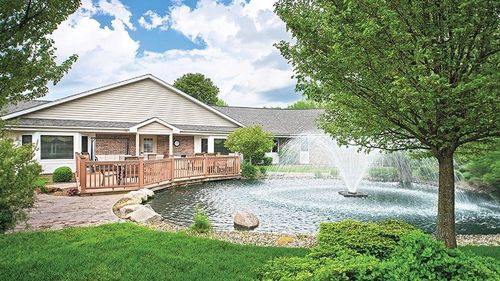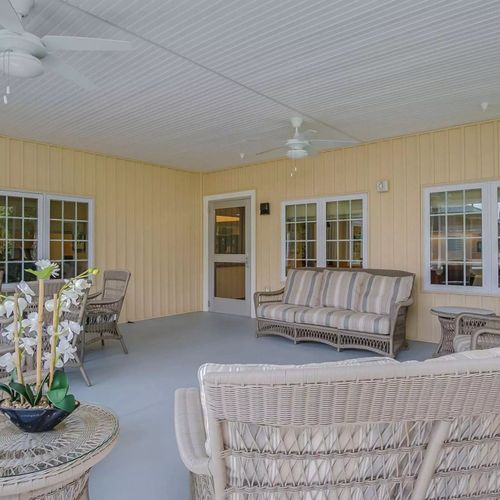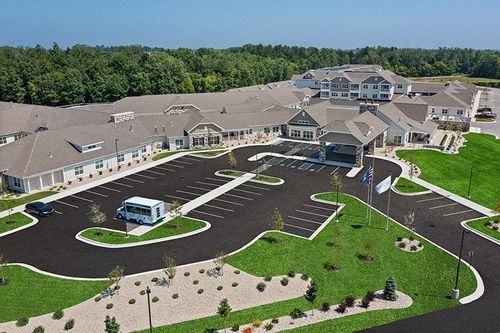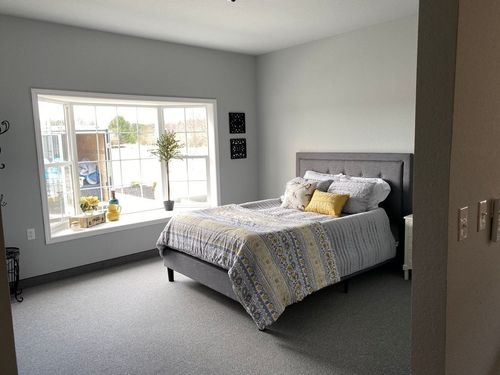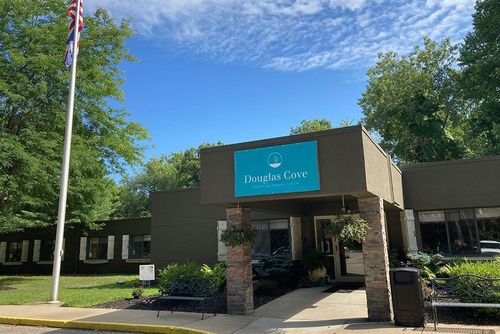

A lakeshore town of barely a thousand people carries the most complete senior-living address in Allegan County, and for a household facing dementia that turns out to be the whole story. The Orchards at Douglas Cove Village on Wiley Road runs assisted living, a secured memory-care setting and skilled nursing under one roof, and it participates in Medicaid, which almost nothing else in the region does.
The significance of that combination is easy to miss. Across most of rural Michigan a move into nursing care means leaving the community, and a household whose money runs out means leaving twice. Here both of those become a change of room, which removes the fear that usually sits underneath a dementia decision.
Secured Care With a Floor Beneath It
The locked setting provides what secured settings provide: exterior doors that stay closed, an enclosed outdoor area, personal help with dressing, washing and eating available at any hour, food altered as swallowing and appetite alter, and staff awake through the night.
What is different is what sits below it rather than what sits inside it. Dementia frequently ends in a period where nursing care is genuinely required, and at most addresses that is the point where a resident is moved somewhere else, usually at short notice and usually badly. On this site the nursing tier is down the corridor, staffed by an organization the resident already knows. Ask what the secured setting can hold before that transfer becomes necessary, what triggers the conversation, and how much notice a family receives, because knowing the sequence in advance is most of the value here.
What Public Funding Changes
The Orchards at Douglas Cove Village charges $4,500 a month for assisted living in 2026, with the secured memory-care setting priced above that. The figure that changes a household's arithmetic, though, is not on the rate card: this address participates in Medicaid, and in this part of the state that is close to unique.
The mechanics are worth being precise about, since Michigan funds long-term nursing care through traditional Medicaid, and it funds care services in assisted and secured settings through the MI Choice waiver, which pays for help rather than for housing. Neither pays a community everything, and eligibility takes time to establish, so the conversation belongs years before it is needed. What participation means practically is that a resident whose savings are exhausted at the nursing stage does not have to be moved out of the building to find a bed that accepts public funding, which in rural Michigan is a genuinely rare protection.
One Complete Address in a Small County
Allegan County's senior housing is thin and scattered, with most towns offering one address or none and very few carrying more than a single level of care. Douglas is a small lakeshore town, and the building on Wiley Road serves well beyond it.
The consequence is that its rooms do not sit waiting, and the secured setting in particular moves slowly. There is no queue to join, so the households who get in are the ones who made themselves known early, and the eligibility groundwork for public funding is far easier to complete before a placement than during one.
Why Allegan Families Keep the Search on the Lakeshore
Dementia makes visits frequent and brief, and the lakeshore towns are close enough together that this stays workable. Family in Saugatuck, Fennville, Holland and South Haven are within a short drive, so someone calls in most days rather than most weekends.
The medical picture is close and adequate, with Holland Hospital twelve miles away, a private not-for-profit of 189 beds covering surgery, cardiology, intensive care, behavioral health and round-the-clock emergency care, which handles nearly everything an older resident meets. Keeping a resident inside that catchment means the doctors and records they already have stay in place.
What a Local Advisor Brings to Douglas
The first contribution here is technical rather than local, because the Medicaid piece is where households make expensive mistakes. An advisor working Allegan County can explain what participation actually covers at each tier, what the eligibility process requires, and how long it takes, which is the difference between a plan and a hope.
The second is timing and fit, because knowing when the secured setting expects a room, what the assessed figure has been for comparable residents, and how the building handles the eventual step into nursing care puts a family in a position to decide rather than react. If a diagnosis is in hand and the money question is somewhere on the horizon, reach out now, because this is the one decision where starting early changes the outcome most.
We keep expanding our Douglas coverage as we evaluate providers for quality and alignment in 2026. Reach out for a conversation about memory care in Douglas, or look through the communities we have vetted at your own pace.