
Cedar City sits 250 miles south of Salt Lake City and 50 miles north of St. George as the Iron County seat, with a senior-living conversation that runs through three local buildings inside the city limits. About 4,100 of Cedar City's 35,200 residents have crossed sixty-five in 2026, which is roughly twelve percent, and that population is served by Our House of Cedar City on Regency Road (a 75-resident SAL Management Group community, the largest of the local set), Three Peaks Assisted Living and Memory Care on the north side (a 42-resident mid-scale community), and All Seasons Senior Living (a 30-resident residential building under the Wasatch Senior Living brand).
Cedar City's senior population draws from two distinct sources that shape the assisted-living conversation differently. Multi-generation Iron County families that have lived around the same wards and ranches for two or three generations make up the local-roots side. Retirees who moved in from elsewhere for the dry climate, Southern Utah University's cultural calendar (the Utah Shakespeare Festival especially), and the proximity to the national-park corridor at Zion and Bryce Canyon make up the migration side. The Shakespeare Festival in particular tends to bring in a slightly more cosmopolitan retiree demographic than the rural southern-Utah baseline.
Daily Support and Resident Independence
All three Cedar City buildings make the same core commitment underneath the scale differences: caregivers cover the parts of the day where help is genuinely needed (medication routines, bathing assistance, dressing support), while the rest of the day stays the resident's own. Meals, weekly housekeeping, laundry, utilities, and the activity calendar bundle into the starting monthly rate at every building.
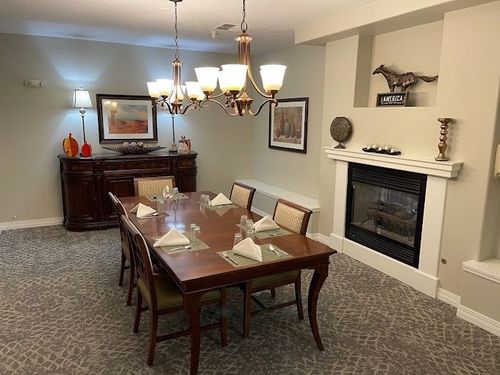
Our House of Cedar City at 75 residents runs at the largest local scale, with restaurant-style dining at multiple seatings, a fuller weekly calendar of outings to the Shakespeare Festival grounds and Main Street, and licensed nursing covering the building during business hours. Three Peaks at 42 residents holds a mid-scale community format, comparable in service depth to Our House but with a smaller resident set and a more concentrated staff-to-resident feel. All Seasons Senior Living's 30-resident residential format moves the building closer to a household than a campus, with family-style meals around shared tables and the tighter caregiver ratios that smaller buildings can offer.
Of the three buildings, only Our House of Cedar City currently welcomes small pets; All Seasons and Three Peaks do not. Transport from each building reaches Cedar City Hospital five minutes away for primary care and inpatient needs, the Coal Creek primary-care office cluster for long-running physician relationships, and Intermountain St. George Regional Hospital forty-five minutes south for cardiac, oncology, and Level III trauma escalations.
Pricing and Affordability
Cedar City assisted-living rates run $3,400 to $5,200 in 2026, with most apartments coming in near $4,100. The local range sits roughly in line with the broader St. George Regional Hospital corridor and meaningfully below central Wasatch Front pricing because Iron County's cost-of-living is lower. Our House of Cedar City holds the upper portion of the band, Three Peaks runs the middle stretch, and All Seasons prices in the lower-middle range on its residential-scale all-inclusive figure.
Neither Our House, Three Peaks, nor All Seasons currently carries an Aging Waiver contract. That's a meaningful gap for Cedar City families on the Medicaid track: the nearest waiver-participating addresses sit forty-five minutes south in Washington County, where St. George and Washington each operate buildings with active contracts. For private-pay families, the local set works well and the Cedar City cost basis remains noticeably more affordable than the Wasatch Front. Move-in fees fall $1,200 to $4,500, second-resident pricing adds $650 to $1,100 monthly, and short-stay respite at the buildings runs $155 to $215 a day.
Who Lives in Cedar City as They Age
Iron County's senior demographic has its own particular shape. The multi-generation families on the local-roots side trace back to ranches, Mormon pioneer settlements, and the small-town economy that anchored southern Utah before the university and the Shakespeare Festival pulled in a different mix. The retiree migration side tends to come from Wasatch Front households trading the larger Salt Lake metro for the dry climate, the cultural calendar, and the lower cost-of-living, plus some northern California and Las Vegas retirees who chose Cedar City over St. George specifically because the elevation makes summers more livable than St. George's hot desert lowlands.
For the three buildings, the small market means apartment turnover stays manageable. Our House and Three Peaks usually refresh standard apartments inside a four-to-six-week window, while All Seasons's smaller residential format cycles fastest of the three because each transition reshapes availability visibly. The secured memory-care wings can stretch to a thirty-to-forty-five-day wait when corridor-wide referrals cluster.
Why Families Choose Cedar City
Cedar City keeps Iron County families inside the same regional fabric they've lived in for decades. Adult children driving in from Enoch, Parowan, Kanarraville, Brian Head, or the surrounding small communities reach a parent's apartment in ten to twenty minutes. The longtime physician relationship at the Coal Creek office cluster, the ward connections built over forty years, and the Sunday-dinner routes already in place all sit inside a tight radius around the city center.
Cedar City Hospital, the Intermountain acute-care facility in town, handles primary care, inpatient work, and post-acute coordination for most residents from five minutes away. Intermountain St. George Regional Hospital, forty-five minutes south on I-15, carries the higher-acuity cardiac, oncology, and Level III trauma cases. The Utah Shakespeare Festival's Adams Theatre, Main Street's historic district, the Cedar City Public Library, and Southern Utah University's adult programs round out the weekly calendar beyond what the buildings program in-house.
What a Local Advisor Brings to Cedar City
In a three-building market that's geographically isolated from the rest of Utah's senior-living inventory, the advisor's role looks different than it does in a Wasatch Front market. The advisor reads the three buildings against the family's specific care-tier need, neighborhood preference, and longer-horizon planning, and tracks live availability across Our House, Three Peaks, and All Seasons. For households where the Medicaid path is the right one, the conversation usually extends to Washington County waiver-participating addresses (Rosecrest, The Abbington at St. George) since none of the three local buildings carries the contract.
Most Cedar City assisted-living calls open in one of three places: an adult child who has watched a parent's medication routine slip while picking up more weekly hours themselves, a Cedar City Hospital discharge planner reaching out about a recent fall or an unresolved infection where the home setting is no longer safe, or a couple where one spouse can no longer reliably hold the household together for the other. In each case, the local three-building set may or may not be the right answer, and the advisor walks through both the in-Cedar-City option and the St. George Regional alternative honestly. For private-pay families, Cedar City almost always wins. For Medicaid-track families, the geography forces a real trade-off.
Our Cedar City directory continues to grow as we evaluate providers for quality and alignment in 2026. Reach out for a conversation about assisted living in Cedar City when planning starts feeling concrete, or look through our Iron County listings at your own pace.