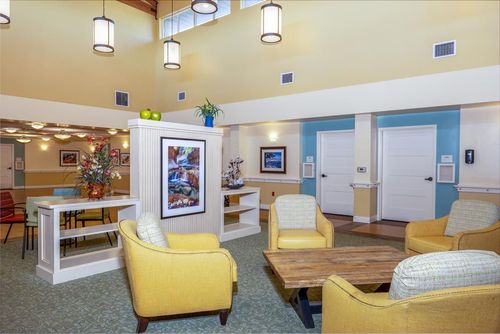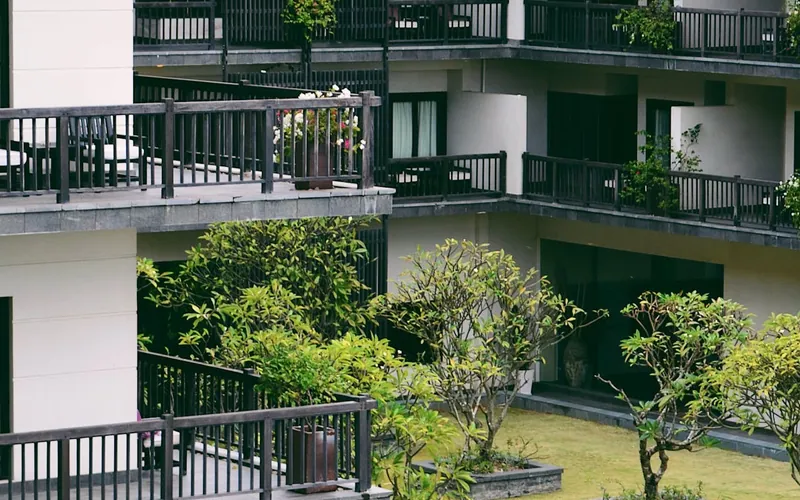
A Hurricane family weighing dementia care often enters the conversation while the resident still lives independently or with light assisted-living help, which makes the local continuum question the more useful frame. Haven at Sky Mountain on 100 North runs all three tiers (independent living, assisted living, and memory-care service) inside the same 90-resident building, so a couple or family member already at Haven on a lighter tier can step into dementia care without relocating, and a new dementia placement at Haven keeps a step-up path open for a spouse later. Oasis Senior Living on 700 West takes the opposite approach, holding memory care inside a 15-resident residential household where the dementia-care environment is the building's entire focus.
Heritage Home, the third Hurricane senior-living building, does not carry memory care. About 4,300 of Hurricane's 20,036 residents are past sixty-five in 2026, a 21.5 percent senior share that ranks among the highest in the directory; applying the national one-in-nine dementia rate translates to roughly 475 Hurricane seniors carrying a dementia diagnosis at any time. The local decision usually turns on environment scale rather than price: Haven's 90-resident continuum supports broader activities variety and the in-building tier progression, while Oasis's 15-resident household provides the smallest dementia-care environment in town for residents who would find a larger building disorienting.
Day-to-Day Care
Dementia-care activities at Haven at Sky Mountain takes advantage of the 90-resident scale to run dedicated activity tracks: music sessions, sensory tabletop work, supervised garden time, and small-group reminiscence circles built around the building's dementia-care residents specifically. The building staffs awake caregivers across the overnight stretch on its memory-care side, runs controlled-entry doors and hallway patterns appropriate for dementia residents, and keeps licensed nursing on call after hours.
Oasis Senior Living's 15-resident household runs a different kind of dementia-care environment. Shared meals at a family-style table, the tightest caregiver-to-resident ratio in the local set, and the household-scale rhythm work well for residents who would find a larger campus environment disorienting. The smaller scale means activities variety is narrower, but the consistency of the daily routine and the familiarity of the staff can be more important for some residents than the breadth of weekly activities.
Family visiting hours stay open every day at both buildings. Routine medical care coordinates through the Hurricane Family Practice physician cluster, and higher-acuity neurology or dementia-specialist consultations route twenty minutes west to Intermountain St. George Regional Hospital.
Cost and Coverage
Oasis Senior Living's 15-resident household sits near the middle of the local range on a single all-inclusive figure; Haven at Sky Mountain's 90-resident continuum runs the top end on its broader continuing-care structure; together the two cover $4,500 to $6,200 monthly in 2026, with most secured apartments near $5,200. The two local pricing positions sit roughly five hundred to nine hundred dollars apart, with that gap reflecting the difference between a small household format and a multi-tier campus. Compared with the central Wasatch Front median, Hurricane memory-care prices read measurably lower because Washington County's overall cost basis runs well beneath the Salt Lake metropolitan area.
Stepping up from the assisted-living tier into Haven at Sky Mountain's secured dementia service typically adds $750 to $950 a month. The premium funds awake-overnight staffing, dementia-trained caregiver ratios, and the building design considerations that the lighter tier does not carry. Aging Waiver participation is absent from both Hurricane addresses, which routes Medicaid-track households into the Washington County corridor to the west when a contracted address becomes the priority. Move-in fees land between $1,500 and $4,000. Couples adding a second resident pay $750 to $1,200 a month on top of the apartment rate, and short-stay respite at the buildings runs $170 to $230 a day.
Local Demand and Availability
Apartment turnover at Haven at Sky Mountain's memory-care service runs on a thirty-to-forty-five-day cadence under normal demand, with the 90-resident scale providing meaningful inventory depth for the local market. Oasis Senior Living's 15-resident format cycles faster because each transition reshapes openings visibly at the small scale.
Same-week placements happen, though usually only when an Intermountain St. George Regional discharge has narrowed the timing to a few days. That path tends to surface whichever building has space inside the release week rather than the building the family would have chosen with more lead time.
Why Families Choose Hurricane
Weekly visit frequency carries more clinical weight in dementia care than in any other senior-living setting, because familiar voices and routines are part of what slows the loss of ground. The Washington County family geography around Hurricane keeps that frequency feasible: a fifteen-to-twenty-five-minute drive covers the run from St. George, Washington, La Verkin, Toquerville, and most of the Zion gateway towns, so a Sunday lunch or a Wednesday afternoon walk-through is not a logistical project.
Medical coverage for the local dementia population layers up cleanly. Primary care runs through the Hurricane Family Practice cluster inside the city limits. Higher-acuity neurology and dementia-specialist evaluations sit at Intermountain St. George Regional, a westbound drive along the State Route 9 corridor that most families already make for other errands. Familiar walking environments around Sand Hollow, Quail Creek, and the State Street historic blocks give visiting family and active-stage dementia residents low-stimulation outings outside the building.
What a Local Advisor Brings to Hurricane
When a Hurricane household reaches the night the front door is found open before sunrise, or the morning a confused resident does not recognize a long-time neighbor, the conversation with the advisor starts with two anchor questions and a quick read of openings. The first question is whether the resident's dementia profile fits Haven at Sky Mountain's 90-resident continuum or Oasis Senior Living's 15-resident household; the second is whether private-pay funding can carry the multi-year plan or whether the search needs to extend out-of-city into the broader Washington County waiver-participating inventory. From there the advisor reads where the resident sits on the progression curve, what scale of building the household prefers, and what the long-horizon financial picture has to support.
Most Hurricane memory-care calls come in after months of trying to layer family schedules and rotating home-care hours around a dementia whose progression has moved past what the household can manage on its own. The familiar triggers in Hurricane households tend to cluster as overnight safety events the family can no longer hold, behavior shifts that exceed what the paid home-care team is trained for, and the cumulative fatigue an adult-child caregiver carries after long stretches of cognitive episodes. Once those signals show up, the advisor compresses the search so the resident lands in a setting matched to the actual dementia profile, rather than the family settling for whichever building has a bed open that week.
Our Hurricane directory keeps expanding as we evaluate providers for quality and alignment in 2026. Start the conversation about memory care in Hurricane, or look through the buildings we cover at your own pace.