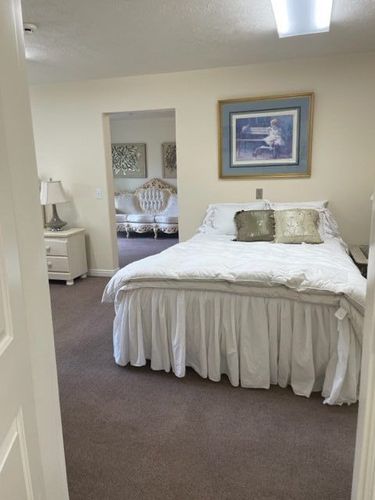

Carbon County has one of the oldest populations in Utah, where nearly one in 5 residents, close to 4,100 people, is past 65, the legacy of a coal-country economy that held onto its retirees as younger workers moved on. In Price, the county seat, Medicaid-accepting senior living centers on Heirloom Assisted Living, a community on North Carbon Avenue run by Rocky Mountain Care, and the count stands at 1 today. Residents who qualify can have the assisted-living care there paid through Utah's New Choices Waiver.
An aging region with modest incomes means a lot of Price families reach the point where the cost of assisted living outruns a retirement built on a mine pension or a Social Security check. When that happens, the waiver is the tool that keeps a resident in a licensed Price home rather than sending the family out of Carbon County to find coverage, and most open that conversation while they are still paying privately.
A Rehab-Linked Home Where Medicaid Funds the Long Stay
Heirloom Assisted Living sits within Rocky Mountain Care's network, which runs short-term rehabilitation alongside longer-term senior care, so the building serves 2 kinds of residents: someone recovering after a hospital stay on a brief Medicare-covered rehabilitation benefit, and someone settling in for ongoing assisted living. For the long stay, the funding question is Medicaid rather than Medicare, because Medicare pays only for the short rehabilitation window and nothing toward extended custodial care. Assisted living here covers the daily essentials, help with bathing, dressing, medication, and meals, for residents who need support but not the round-the-clock nursing of a skilled facility.
Utah's New Choices Waiver is the Medicaid route that pays the care-services portion of that assisted-living stay, for a resident who meets nursing-facility level of care. Because Price sits more than a hundred miles from the Wasatch Front, a single home carrying that coverage matters more here than it would in a metro area with dozens of choices. A qualifying resident can have the hands-on care funded while staying with familiar local staff, instead of relocating to chase a waiver bed.
What Care Costs in a Rural County, and Where Medicaid Lands
Assisted living in Carbon County tends to run at or below Utah's statewide median of roughly 5,475 dollars a month, since a rural market with lower housing and labor costs rarely carries the prices of a Salt Lake suburb, and far under the 6,200-dollar national figure for assisted living in 2026. When a resident qualifies, the waiver absorbs the care piece of that bill, the day-to-day help a resident actually receives, and leaves the room-and-board piece, the rent and meals, on the resident, usually paid from monthly income.
Using the waiver turns on two tests: the financial one in 2026 allows a single applicant up to 2,982 dollars in monthly income and no more than 2,000 dollars in countable assets, leaving out a home, a car, and personal belongings, while the functional one calls for nursing-facility level of care, the same threshold a nursing home would apply. Applicants who hold more than the asset limit can spend down toward it, with Utah looking back several years at gifts and transfers. None of this reaches independent living, which Medicaid never funds because it carries no care need.
An Older County Leaning on a Single Waiver Home
The arithmetic of an aging county puts steady pressure on a small amount of Medicaid-accepting inventory. With roughly 4,100 Carbon County residents already past 65 and that share among the highest in the state, demand for waiver-funded assisted living in Price runs ahead of what one home can always absorb. A qualifying resident is not promised a room, both because the New Choices Waiver is capped statewide and because Heirloom Assisted Living holds a finite number of beds. Families who anticipate needing Medicaid usually do best to begin the eligibility work early, before a hospital discharge or a sudden decline forces the timing.
Far From the Wasatch Front, and Better Off Local
Price sits in a high desert basin more than 2 hours from the Salt Lake Valley by way of the canyon, far enough that moving a resident out of Carbon County for care would put a long, weather-prone drive between them and everyone who visits. For families whose roots run back generations in the coal towns of Carbon and Emery counties, that distance is not abstract; it is the difference between a daughter dropping by after work and a trip that has to be planned around a day off. A Medicaid-accepting home in Price keeps a resident near the same streets, the same congregation, and the doctors at Castleview Hospital who may already know their history. Affording that closeness, rather than chasing a cheaper bed far away, is the practical reason a local waiver-funded room is worth the effort to secure. For the resident, it means the mesa and the familiar Main Street stay part of daily life.
An Advisor's Job When the County Has One Medicaid Home
Clearing eligibility comes before anything else in Carbon County, since a single Medicaid-accepting home leaves no room for error: an advisor confirms a resident actually meets nursing-facility level of care and the financial limits, then checks whether Heirloom Assisted Living has a waiver-funded room open before a family pins its plans to it. Those answers are hard to pull from a directory listing, and getting them wrong can cost a family weeks.
An advisor also coordinates the moving parts that a Price family rarely faces twice, the waiver application, the level-of-care assessment, and a Castleview discharge that may be driving the timeline. Get in touch about Medicaid-accepting senior living in Price, and an advisor can walk through where the application stands and when a room is likely to open.