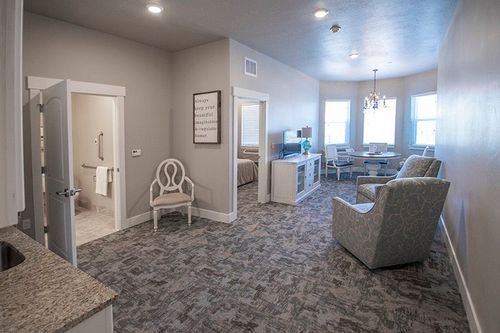


Taylorsville stands out among its neighbors for having two Medicaid-accepting communities rather than one, and both lean heavily toward memory care. The Medicaid-accepting list here runs to 2: Legacy Village Memory Care, a 42-bed secured community on 3200 West, and Legacy House of Taylorsville on Gold Medal Drive, which pairs assisted living with its own memory-care wing. Both are run by the same Utah senior-living company on the city's west-central side near Redwood Road. Taylorsville is a large, middle-income suburb where the senior share is moderate, so two waiver-accepting buildings weighted toward dementia care give local families more of a real choice than most valley cities can offer.
In Taylorsville, the Medicaid question often arrives alongside a dementia diagnosis, when a family realizes that memory care is both necessary and, at private rates, out of reach on a fixed income. Utah's New Choices Waiver is what brings a secured memory-care or assisted-living setting back within reach for a resident who qualifies, without a move out of the area.
How the Waiver Reaches Memory Care and Assisted Living Here
The two Taylorsville buildings cover slightly different ground, and Medicaid reaches both through the same channel. Legacy Village is a secured community built entirely for residents living with Alzheimer's or another dementia, while Legacy House offers assisted living next to its own memory-care wing. In each, the New Choices Waiver pays for the care a resident receives, the help with bathing, dressing, medications, supervision, and for memory care the closer monitoring a secured setting demands, as long as the resident's needs reach a nursing-home level of care and the long-term-care Medicaid limits are met. The one piece the waiver never picks up is housing, so a resident puts room and board toward the bill from monthly income while Medicaid carries the care, the same division whether the setting is assisted living or memory care. Because Legacy House can shift a resident from assisted living into memory care as dementia progresses, a family can sometimes settle on one building and let the level of care change inside it, with the waiver tracking the care rather than the address. Skilled nursing is a separate route that neither building provides, and it is paid for under traditional Medicaid rules rather than through this waiver.
What Memory Care Costs Here, and Where Medicaid Helps
Memory care sits at the costlier end of senior living, and Taylorsville's numbers show it. A secured setting like Legacy Village runs higher than standard assisted living, with private rates quoted as $4,500 - $6,600/mo a month, while assisted living at Legacy House lands noticeably lower and sits below the statewide assisted-living figure in current national care-cost data for 2026. For a resident who clears the requirements, the New Choices Waiver pays the care portion of either rate, which on a memory-care bill is the largest part, and leaves the room-and-board portion to the resident, drawn from monthly income after the state's small personal-needs allowance. That housing share is what catches families who assumed the waiver wiped out the entire memory-care rate. Traditional Medicaid treats skilled nursing differently, but neither Taylorsville building offers that level, so the waiver is the route for both memory care and assisted living. Independent living has no Medicaid path at all, since the program funds care and not a residence, though neither Taylorsville building offers that tier in any case.
A Moderate Senior Share, Two Ways In
About 7,900 of Taylorsville's roughly 60,000 residents are 65 or older, a moderate senior share that falls between the older benches and the younger west-side suburbs. What sets the city apart is less the size of that group than the fact that two communities here take the waiver, both with memory care, where most valley cities have one or none. That still does not promise an open room, since each building holds a limited number of waiver-funded beds and the New Choices Waiver is capped across the state, so eligibility and availability stay separate questions. Two buildings do raise the odds that one has space when a family is ready, which is the real edge Taylorsville brings to a memory-care search.
Why a Memory-Care Move Often Stays in Taylorsville
For a Taylorsville family, part of the appeal of keeping a memory-care move local is simply having a choice at all. Two waiver-accepting buildings near Redwood Road mean a resident rarely has to cross the metro to chase a single open memory-care bed, and can stay in the west-side neighborhoods where the people who visit most already live. That nearness counts for more in dementia care, where steady family visits and familiar faces genuinely shape how a resident settles in. Both buildings sit minutes from the hospitals and clinics on the valley's west side, which helps as medical needs grow alongside cognitive ones. For families eyeing a cheaper option farther out, the waiver usually makes the trade pointless, since it brings a licensed local community within reach and keeps a resident close to the people who steady them.
Choosing Between Taylorsville's Two Waiver Buildings
When a city has two Medicaid-accepting buildings instead of one, the work shifts from finding a bed to choosing well between them. The advisor knows the day-to-day difference between Legacy Village, built entirely around secured memory care, and Legacy House, where assisted living and memory care sit side by side, and which of them currently has a waiver-funded room. For a resident whose dementia is advanced, the fully secured community may fit better; for someone who still needs only light help now, the building that can raise the level of care later may be the wiser start.
The advisor also tracks where each building's waiver beds and eligibility timelines stand, since two communities can both take the waiver yet have very different openings in a given month. Talk with us about which Taylorsville community fits a resident's care level and budget, or take your time with the communities we have already looked over.