

Washington shares the southern Utah desert with neighboring St. George, and the warm-winter climate, red-rock backdrops, and Sunbelt retirement pattern shape where assisted living lands inside the city. The five buildings, Primrose, Autumn Park Assisted Living, Ovation Sienna Hills, and the two Oasis Senior Living residential homes, cluster between the Telegraph Street corridor and the Coral Canyon foothill blocks, near the I-15 spine connecting Washington to St. George.
More than one in four Washington residents has passed sixty-five in 2026, well above Utah's statewide share. The pattern reflects steady retirement migration. Households arrive from California, the Pacific Northwest, and northern Utah, drawn to mild winters, the sandstone-and-juniper landscape, and budget elasticity relative to most coastal markets. Families approach the assisted-living conversation when an in-home setup that worked through years of retirement begins struggling to keep medication timing, bath safety, and routine household management on track, especially as the desert summer heat raises the stakes on falls and dehydration.
Care Routines and Daily Life
Inside Washington's local inventory, assisted-living days run on a calendar that combines steady caregiver presence at the heavier moments with substantial blocks of resident-controlled time. A morning medication round, bath support, dressing help, three daily meals, weekly cleaning, and laundry service belong to the headline monthly figure. Licensed nurses staff Primrose, Ovation Sienna Hills, and Autumn Park during business hours with on-call coverage after; the two Oasis Senior Living homes run residential-scale staffing tuned to their sixteen-resident layout.
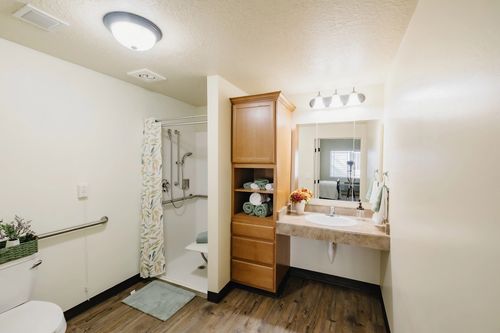
Dining at the larger campuses operates as restaurant-style sit-downs with menu choices at each meal; the residential Oasis homes gather residents around a shared family table. Activities runs morning fitness suited to mild desert mornings, devotional services, music and art sessions, group outings to Sand Hollow State Park or Pioneer Trail, and rides to the Washington City Community Center and the senior wing on Telegraph Street. Scheduled rides cover medical appointments at Intermountain St. George Regional Hospital, primary-care offices along River Road, and weekly grocery loops to Smith's, Lin's Market, and Walmart along Washington Fields Road and Telegraph. Apartments stay private with kitchenettes and full bathrooms.
Local Pricing in 2026
For Washington families weighing affordability, monthly figures typically run $3,500 to $5,200 for assisted living in 2026, with the citywide average near $3,900. Primrose anchors the upper portion of the band; Ovation Sienna Hills sits in the upper-mid; Autumn Park holds the mid-range with its Medicaid Aging Waiver contract; the two Oasis Senior Living homes price in the lower-mid band on all-inclusive residential rates.
Three variables usually drive most of the spread: floor-plan size, the care-tier rating set during the move-in assessment, and whether the building presents one all-inclusive monthly figure or breaks out care services as a tiered add-on. Washington rates run $500 to $900 below central Salt Lake County, a reflection of southern Utah's more volume-driven, openly competitive senior-living market. Autumn Park currently carries the only Aging Waiver contract in Washington's local inventory. For veterans whose service records qualify them, VA Aid and Attendance can layer over private-pay or Medicaid coverage to add monthly support.
Retirement Migration and the Building Mix
Washington's older-resident base has grown steadily as retirees continue moving into southern Utah from outside the region, drawn by mild winter weather, the red-rock setting, and household budgets that stretch further than they would on the coasts. The roughly 26 percent share of residents past sixty-five in 2026 runs well above the Utah norm and shapes both the building mix and the demand pattern.
Local demand against the five buildings stays manageable through most of the year. Apartments at Primrose, Ovation Sienna Hills, and Autumn Park typically free up across a five-to-seven-week stretch for standard care tiers; the residential Oasis homes turn over fastest. The secured memory-care wings at Primrose and Ovation Sienna Hills run a thirty-to-forty-five-day wait when demand peaks during fall and winter migration.
Why Households Choose Washington
Households gravitate toward Washington because the southern Utah climate keeps outdoor life part of the weekly routine for far more of the year than Wasatch Front winters allow. Pioneer Trail, the Washington Fields paths, and the trails around Sand Hollow stay walkable nearly every month, and the dry desert atmosphere is gentler on arthritic joints and breathing than the inversion seasons up north.
Distance from far-flung family is the second draw. Las Vegas, the Phoenix corridor, southern California, and the Wasatch Front each fall inside a single day's drive of Washington, which preserves Sunday visits and holiday weekends as regular events instead of phone-only check-ins. The continuing-care setup at Primrose and Ovation Sienna Hills gives couples a structure for planning around future care progression without locking the household into a second move years out. Walkable retail at the Washington Towne Center, the Coral Canyon retail blocks, the Washington Branch Library, and the city's senior-activities center on Telegraph Street fill out the weekly social rhythm.
Bringing an Advisor into the Search
An advisor covering Washington usually compresses the five-building shortlist to two strong fits after a single half-hour call about doctor, neighborhood, budget, and care needs. Waiver eligibility and VA pathways factor in when the household profile supports them. The advisor keeps live openings at Primrose, Ovation Sienna Hills, Autumn Park, and the two Oasis Senior Living homes, plus working knowledge of Autumn Park's waiver bed cycle relative to a family's planning window.
For households facing a dementia diagnosis, partners at different care levels, or an Intermountain St. George Regional Hospital discharge, the advisor lays out every trade-off in a single conversation rather than dragging the household through repeated admissions-office calls. The first call before the in-home arrangement reaches a hard ceiling is what keeps the Washington inventory open while the household still has flexibility.
Our Washington directory keeps adding buildings as new ones open along the I-15 corridor in 2026. Talk it through with our team to discuss Washington assisted-living options, or look at the full set we have vetted at your own pace.