Washington's mild desert climate and red-rock landscape pull retirees south from Salt Lake County, the Wasatch Front, and out-of-state markets, which gives the city a senior share well above the Utah norm. The two matching independent-living communities, Primrose and Ovation Sienna Hills, sit a few minutes apart inside the Washington Fields and Sienna Hills neighborhoods, both walking distance to the Washington Senior Activity Center and within easy reach of Intermountain St. George Regional Hospital. Both buildings carry on-site assisted-living and memory-care wings, so households planning across a longer horizon can stay at the same address as care needs change.
Roughly seven thousand of Washington's thirty thousand residents are past sixty-five in 2026, but most of those retirees actually live in single-family homes through Coral Canyon, Stucki Farms, and the Telegraph Street blocks, with the two buildings covering the apartment-style end of the market for households ready to leave the yard work, summer cooling bills, and house upkeep behind.
Daily Routines and Building Services
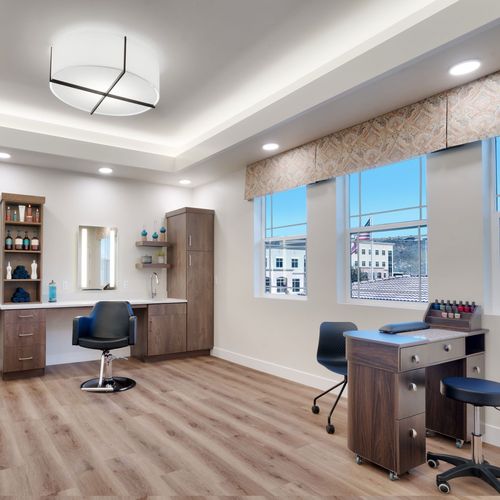
A weekday at Primrose or Ovation Sienna Hills takes the running list of single-family home tasks (yard work, weekly cleaning, repair coordination) off the resident's plate and replaces it with a dining-room meal program, on-staff housekeeping, and an in-house maintenance team. Residents keep their own medication routines, schedule their own visits at Intermountain St. George Regional Hospital, and hold the front-door key.
Dining at both campuses runs restaurant-style for two or three meals a day, and the apartment kitchens stay equipped well enough for grandchildren visits and a private breakfast. The weekly schedule at both campuses fills out with morning water aerobics, bus outings to Pioneer Park, Snow Canyon, Tuacahn Amphitheatre, and the St. George Regional Tabernacle, on-campus fitness and art classes, and resident-organized clubs. Apartments at both buildings are private full-bathroom layouts, though pet policies vary (Ovation Sienna Hills tends to be more pet-permissive than Primrose's tighter limits).
What It Costs
Moving into independent living from a single-family home in Coral Canyon or Stucki Farms typically trades the yard-and-utilities outlay for a $3,500 to $4,800 monthly figure on a one-bedroom apartment in 2026, averaging $4,000 across the mid-scale band. Both buildings run continuing-care campuses with similar pricing structures, and the differences across one-bedroom floorplans typically come down to view, square footage, and amenity tier rather than building-to-building gaps.
The monthly figure ordinarily wraps in the dining program, activity calendar, light cleaning, utilities, scheduled transportation, and apartment maintenance. Choosing a two-bedroom layout adds $500 to $900; bringing a second resident onto a shared apartment adds $700 to $1,000. Care hours that a resident later draws at the assisted-living or memory-care wings price as separate billing, rather than rolling into the apartment fee. Washington pricing sits roughly in line with St. George's continuing-care campuses, mainly because the two cities share most of the same labor market and amenity infrastructure. For the area's high veteran population, VA Aid and Attendance is a meaningful pathway once a clinical assessment qualifies a resident for a higher care tier.
Senior Population and Demand
Washington's senior share has grown faster than almost any other Utah city's because retirement migration from California, the Phoenix Valley, and the Wasatch Front continues at a steady pace. The two buildings absorb the apartment-side demand, and the larger share of senior households continues to live in single-family homes through the city.
Apartment turnover at Primrose and Ovation Sienna Hills generally moves on a six-to-ten-week cadence, slower than the central Wasatch Front because southern Utah snowbird patterns keep residents in place through the warm months and turnover tends to concentrate around the seasonal transitions.
Why Families Choose Independent Living in Washington
Washington carries the same retirement draw that pulls households to the southern Utah corridor: dry desert air, mild winters, red-rock landscapes a short drive from the Snow Canyon trails and Pioneer Park overlooks, and a community pace tuned to retirement rather than working life. Adult children driving in from California, the Phoenix Valley, the Wasatch Front, and Las Vegas reach the area inside a half-day, which makes weekend visits realistic without the long flights some families plan around.
For couples weighing the longer view, both Primrose and Ovation Sienna Hills run continuing-care campuses with assisted-living and memory-care wings on site, so a partner's eventual care progression does not force a move to a different building. The Washington Senior Activity Center, the city's bike-trail network, the Tuacahn Amphitheatre, and the Pioneer Park overlook extend weekly schedules beyond what either building offers internally.
What a Local Advisor Brings to Washington
An advisor working the southern Utah corridor mostly walks Washington families through the trade-offs between Primrose's smaller-footprint design and Ovation Sienna Hills's larger newer campus, given that both share continuing-care setups and similar pricing bands. The advisor tracks current openings at both buildings and reads how each manages the eventual move from an independent-living apartment into the assisted-living or memory-care wings.
The advisor also reads the option of staying in a Coral Canyon or Stucki Farms single-family home with home-health hours added, when that arrangement actually serves the household better than either matching building does. The conversation also includes the St. George local inventory (Legacy Village of St. George, The Abbington, Temple View) when a household's neighborhood preference points slightly west. Talk it through before any household event tightens the planning calendar, and the field clarifies in one sitting.
Our Washington listings keep expanding as new buildings open across the southern Utah corridor in 2026. Talk it through and the field clarifies; or look through the communities we have vetted on your own time.