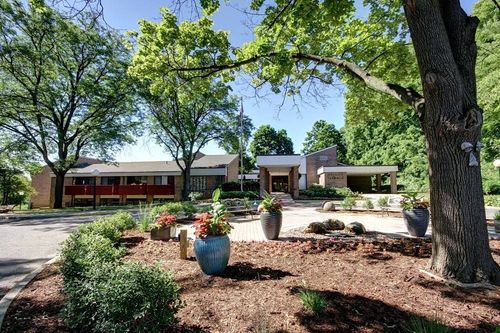


An independent apartment in Chelsea buys a position in a queue as much as it buys a place to live. Both local addresses are continuing-care campuses carrying assisted living and a secured neighborhood on the same grounds, and one of them runs nursing care too, so the whole ladder exists inside the town rather than across a county.
That changes what the 2 apartment options are really being compared on. A household choosing between them is deciding which organisation it wants standing with when health changes, because a resident already living on the campus is a known quantity when a care wing has a vacancy, and the alternative is starting a search from outside at the worst possible moment.
What the Apartment Tier Actually Provides
Residents at this level run their own lives, holding on to medications, appointments and the shape of a week, while the campus absorbs the maintenance, the yard work, the roof, the meals a resident wants and the housekeeping, along with transport into Ann Arbor and around town, so what changes hands is time rather than care.
Both campuses are large enough to make that worth having, running between seventy-one and eighty-five rooms across the site, which sustains a weekday calendar and a dining room with enough people in it. One of the two takes respite stays, and neither accepts pets, which is worth establishing early rather than late, because for some households it settles the question by itself.
Cost Now, and Cost Later
Independent living is the cheapest tier on either campus, and the difference between the two at this level reflects the apartments and what the monthly figure absorbs rather than any care a resident is not yet using. Compare what is bundled: whether meals come with the apartment or are bought separately, how utilities and parking are treated, where the shuttle actually goes, and what a partner adds to the bill.
The numbers that matter more sit further up the site, since both campuses publish rates for assisted living and for their secured neighborhoods, and one carries a nursing rate as well, so a household can see the entire cost of the next fifteen years before committing to the first year of it. One of the two campuses participates in Medicaid, which is genuinely unusual for a continuing-care community and matters for a household expecting to outlive its savings.
A Young County With an Older Town
Washtenaw County is young by Michigan standards, with about 60,300 residents past 65 out of roughly 370,000, some 16.3 percent against the state's 19.6. That older population does not distribute evenly, and it concentrates in towns like Chelsea rather than in Ann Arbor.
For independent living the effect is a slow-moving market. Apartments on a continuing-care campus are held for years rather than months, so a household with a horizon in mind is far better served looking early than waiting for a vacancy to surface.
Why Households Commit to Chelsea Early
The town itself is the draw: a walkable centre, a theatre and a farmers' market, and a scale that keeps a resident recognised in the shops rather than anonymous. People who move here at seventy-five tend to have been coming for years already.
Medically it is a strong position, because Chelsea Hospital sits under a mile from both campuses, a 133-bed joint venture between Trinity Health and University of Michigan Health that runs a separate senior emergency room alongside its main department. Anything beyond it travels seventeen miles east into Ann Arbor, where University of Michigan Health carries 550 beds, Level I trauma verification and a national geriatrics ranking.
What a Local Advisor Brings Before Anything Is Urgent
Independent living is the one tier where a household usually has time, and time is the resource most often left unused. A Local Senior Advisor covering the Chelsea area knows what each apartment rate absorbs, what the care tiers on the same site cost, how each campus treats an existing resident when a care wing is full, and what Medicaid participation actually means in practice at the campus that has it.
Because this is a fifteen-year decision rather than a three-week one, the conversation is more useful now than it will ever be in a crisis. A household that has already picked its campus moves on its own schedule rather than a hospital's, and a short conversation is enough to set that up.
Our Chelsea directory keeps expanding as we evaluate providers for quality and alignment in 2026. Start the conversation about independent living in Chelsea, or look through the buildings we cover at your own pace.