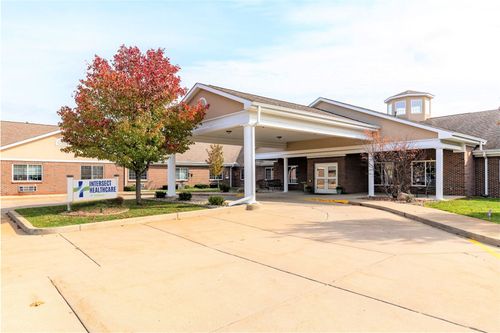

Chelsea is one of the few towns in Michigan where a family can see both kinds of rehabilitation within a mile of each other, and almost nobody realises there are two kinds. Chelsea Retirement Community, published from $6,559 a month, provides skilled nursing and takes Medicaid. The hospital in the same village runs a separate adult inpatient rehabilitation unit, and the two do different jobs for different patients.
Getting that distinction right at the point of discharge matters more than choosing between buildings, because the wrong setting either wastes weeks or fails outright.
Two Kinds of Rehabilitation
Inpatient rehabilitation in a hospital is intensive, aimed at patients who can tolerate several hours of therapy a day and who have a realistic prospect of substantial recovery, typically after a stroke, a brain injury, major trauma or complex surgery, with physician oversight at hospital level throughout.
Skilled nursing rehabilitation is less intensive and lasts longer. Therapy runs most days rather than for hours a day, nursing cover is continuous, and it suits somebody who needs to regain strength and function at a pace their body will actually accept. A frail patient after a hip fracture, or somebody recovering from pneumonia who cannot yet manage stairs, usually belongs here rather than in the intensive setting, and a referral to the wrong one is corrected slowly.
How the Money Differs
Medicare pays for both after a qualifying hospital admission, and in each case the benefit lasts only while a patient keeps improving. On the skilled nursing side the ceiling is a hundred days, the first stretch is free and a daily contribution starts partway through, and the moment a stay stops being rehabilitation and becomes permanent residence, Medicare exits altogether.
That is where the local address matters, because Chelsea Retirement Community participates in Medicaid, so a resident whose rehabilitation turns into a permanent stay does not necessarily have to move again in order to be funded, which in a village with one skilled nursing address is worth a great deal. Households with private means still pay privately first; the point is that there is somewhere for the plan to land.
Why the Village Setting Helps Recovery
Recovery goes measurably better when family can attend a therapy session and see for themselves what somebody can and cannot manage, because it converts an abstract discharge conversation into a practical one about a specific staircase and a specific bathroom.
Chelsea makes that unusually easy, with Washtenaw County families mostly within twenty minutes, the hospital and the nursing address are a short distance apart, and a patient moving between them is not being sent to another town at the point they are least able to absorb change.
What a Local Advisor Brings to a Chelsea Discharge
The useful contribution is getting the category right and getting it early. A Local Senior Advisor will find out what is genuinely open, press the building on whether it regards this as a short rehabilitation or the start of a permanent stay, and set out what the bill becomes the day Medicare steps back.
Where a patient is unlikely to go home, knowing that in the first week rather than the fourteenth changes what a family can arrange. Reach out as soon as rehabilitation is mentioned, because the options are widest at the start and narrow steadily from there.
The Chelsea directory continues to grow as we evaluate providers for quality and alignment in 2026. Start the conversation about skilled nursing in Chelsea, or look through the buildings we cover at your own pace.